Advertisement
Links marked with * are affiliate links. If you buy through one, we may earn a commission at no extra cost to you. It never changes what we recommend. As an Amazon Associate I earn from qualifying purchases. How we make money
Quick answer
One two-pin adapter covers 28 of these 32 countries.
4 picks
For anything with a two-pin US plug, such as a phone, tablet or camera charger, a two-round-pin (Type C) adapter works in 28 of the 32 countries on this page. The UK, Ireland, Malta and Cyprus use a three-pin plug (Type G). No adapter changes the voltage, so look for “100-240V” on each device’s label first. We didn’t test the adapters below. Details come from the makers’ pages.
Which adapters does your trip need?
Checked Nov 10, 2026
Europe has three kinds of socket, not one
There is no single European plug. For a traveler from the US, the 32 countries on this page fall into three groups.
Two round pins: 24 countries. Austria, Belgium, Bulgaria, Croatia, Czechia, Estonia, Finland, France, Germany, Greece, Hungary, Iceland, Latvia, Lithuania, Luxembourg, the Netherlands, Norway, Poland, Portugal, Romania, Slovakia, Slovenia, Spain and Sweden. The slim two-pin plug is called Type C. The wall sockets are its grounded relatives, Type E or Type F, and a Type C plug fits both.
Three rectangular pins: 4 countries. The UK, Ireland, Malta and Cyprus use Type G. A round-pin adapter does not fit these sockets.
A national plug, and the two-pin one as well: 4 countries. Switzerland and Liechtenstein (Type J), Italy (Type L) and Denmark (Type K) each have their own three-pin grounded plug. Their sockets also take the slim two-pin Type C plug. Switzerland’s tourism board says it plainly: “Type C 2-pin plugs also fit J sockets.” For Italy and Denmark we rely on the plug reference WorldStandards, which lists Type C next to the national plug. One exception in Italy: the socket style made for the larger 16-amp Italian plug takes only that plug.
So what you pack comes down to two questions: which group your countries are in, and whether your US plug has two pins or three. The checker answers both for your trip.
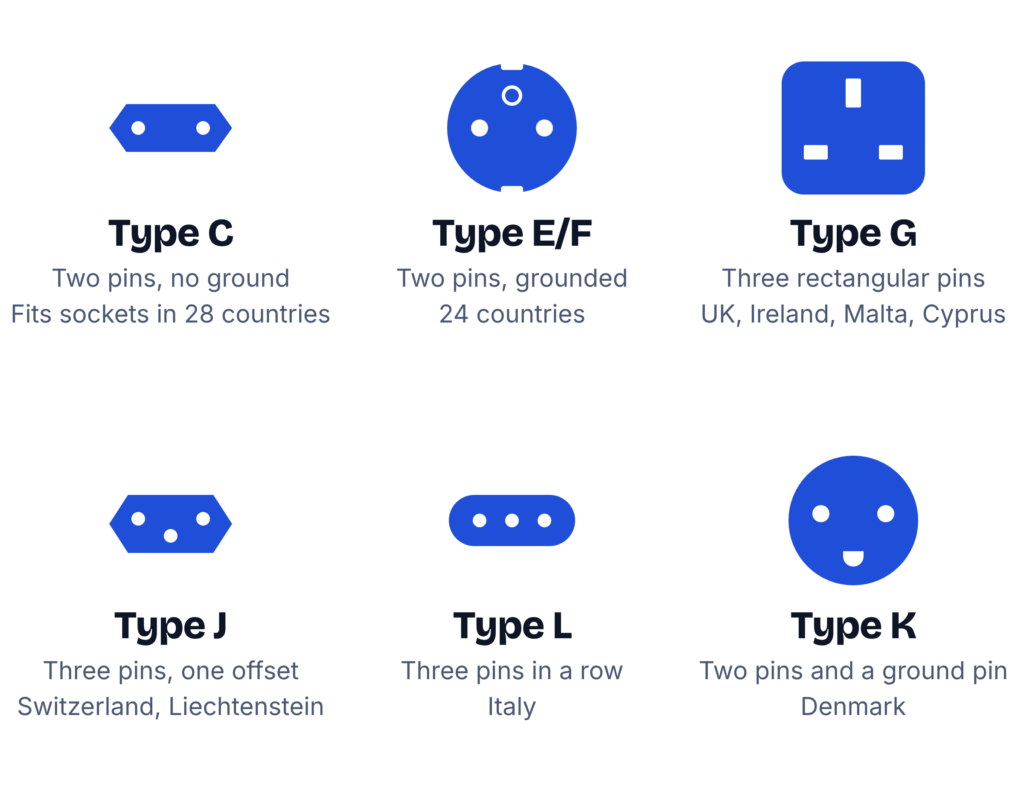
Plug type in each country, and what to pack
Every country in this table runs on about 230 volts at 50 Hz. Official pages write it as 220, 230 or 240 volts. For a US device the answer is the same either way, and the voltage section covers it.
| Country | Plug types | Two-pin US plug: pack | Three-pin US plug: pack | Sources |
|---|---|---|---|---|
| Austria | C, F | Type C | Type E/F | ITA 2004; WS 2025; trade.gov |
| Belgium | C, E | Type C | Type E/F | ITA 2004; WS 2025 |
| Bulgaria | C, F | Type C | Type E/F | ITA 2004; WS 2025 |
| Croatia | C, F | Type C | Type E/F | ITA 2004; WS 2025 |
| Cyprus | G | Type G | Type G | ITA 2004; WS 2025; trade.gov, Apr 2026 |
| Czechia | C, E | Type C | Type E/F | ITA 2004; WS 2025; trade.gov |
| Denmark | C, E, F, K | Type C | Type K | ITA 2004; WS 2025 |
| Estonia | C, F | Type C | Type E/F | ITA 2004; WS 2025; trade.gov, Feb 2026 |
| Finland | C, F | Type C | Type E/F | ITA 2004; WS 2025; trade.gov |
| France | C, E | Type C | Type E/F | ITA 2004; WS 2025 |
| Germany | C, F | Type C | Type E/F | ITA 2004; WS 2025; trade.gov, Aug 2025 |
| Greece | C, F | Type C | Type E/F | ITA 2004; WS 2025 |
| Hungary | C, F | Type C | Type E/F | ITA 2004; WS 2025 |
| Iceland | C, F | Type C | Type E/F | ITA 2004; WS 2025; trade.gov, Apr 2026 |
| Ireland | G | Type G | Type G | ITA 2004; WS 2025; trade.gov, Feb 2026 |
| Italy | C, F, L | Type C | Type L | ITA 2004; WS 2025 |
| Latvia | C, F | Type C | Type E/F | ITA 2004; WS 2025 |
| Liechtenstein | C, J | Type C | Type J | ITA 2004; WS 2025 |
| Lithuania | C, F | Type C | Type E/F | ITA 2004; WS 2025 |
| Luxembourg | C, F | Type C | Type E/F | ITA 2004; WS 2025 |
| Malta | G | Type G | Type G | ITA 2004; WS 2025; VisitMalta |
| Netherlands | C, F | Type C | Type E/F | ITA 2004; WS 2025; trade.gov, Jan 2026 |
| Norway | C, F | Type C | Type E/F | ITA 2004; WS 2025; trade.gov, Jun 2026 |
| Poland | C, E | Type C | Type E/F | ITA 2004; WS 2025; trade.gov, Apr 2026 |
| Portugal | C, F | Type C | Type E/F | ITA 2004; WS 2025; trade.gov |
| Romania | C, F | Type C | Type E/F | ITA 2004; WS 2025 |
| Slovakia | C, E | Type C | Type E/F | ITA 2004; WS 2025; trade.gov, Mar 2026 |
| Slovenia | C, F | Type C | Type E/F | ITA 2004; WS 2025 |
| Spain | C, F | Type C | Type E/F | ITA 2004; WS 2025; trade.gov, Jul 2024 |
| Sweden | C, F | Type C | Type E/F | ITA 2004; WS 2025; trade.gov, Apr 2026 |
| Switzerland | C, J | Type C | Type J | ITA 2004; WS 2025; Switzerland Tourism |
| United Kingdom | G | Type G | Type G | ITA 2004; WS 2025; Visit London |
How to read the sources. “ITA 2004” is the US Commerce Department’s Electric Current Worldwide table, which uses the same plug letters; its data is from 2003 and 2004, and its web page no longer loads. “WS 2025” is WorldStandards’ by-country list, updated Sep 7, 2025. A third name is a current official page: a US Commerce Department country guide or the national tourism board. The plug letters shown are the current ones from WS 2025.
Where the two lists disagree. The older US table gives Latvia, Lithuania and Slovenia a Type E socket where the newer list says Type F. It also lists an old Type D socket for Greece, a two-pin Type C for the UK, and only Type L for Italy. None of this changes what you pack: a Type E/F adapter is made to fit both grounded sockets, and Type C fits either.
Why there is no single official list. The International Electrotechnical Commission retired its World Plugs guide; its page now says the guide “is no longer available”. So each row here names where it comes from.
Denmark, one more detail. WorldStandards rates Type E and F plugs in a Danish Type K socket as “partial and unsafe compatibility”: they go in, but the ground does not connect. For a three-pin plug in Denmark, take the Danish Type K adapter.
Do you need a voltage converter in Europe?
Usually not. An adapter only changes the shape of the plug. It does not change the electricity, and every maker on this page says so about its own adapter.
US outlets supply 120 volts at 60 Hz. The countries in the table supply about 230 volts at 50 Hz. Whether that matters depends on one line printed on your device or its charger.
The label says “100-240V” or “110-240V”. The device handles both. You need an adapter and nothing else. Many phone, tablet, camera and laptop chargers are built this way, but read the label on yours.
The label says “120V” or “110V” only. The device is built for US power. Through an adapter alone, a European socket gives it about twice the voltage it was made for. The US Commerce Department’s guide for travelers to the UK states the same rule: appliances that handle 110 to 240 volts need only a plug adapter, and items that handle only 110 volts need a step-down transformer.
Where to look. The line is in the small print on the charger or near the power cord, often after the word “Input”.
Hair tools are the usual trouble. TESSAN warns buyers of its adapter about hair dryers, straighteners, curlers, electric toothbrushes and razors that are not dual-voltage.
Check the watts too. An adapter has its own limit, and a hair dryer draws far more power than a phone charger. Anker states that the outlet on its universal adapter tops out at 1,380 watts on European power. TESSAN states 2,500 watts for its Type C adapter. Compare the watt figure on your device with the one on the adapter.
We don’t list voltage converters on this page. If a device is 120V only, the simple choices are to leave it at home or to travel with one sold as dual-voltage.
Does a three-pin US plug need a different adapter?
Yes. Look at the plug you are taking. Two flat pins is one case. Two flat pins and a round one is the other: the round pin is the ground. Laptop power cords are often built this way.
A Type C adapter ends in two pins, so it cannot carry the ground through to the wall. For a grounded plug, makers sell grounded adapters, and which one depends on the country:
- The 24 two-round-pin countries: Type E/F. Ceptics describes its Type E/F adapter as a grounded 3-prong plug that accepts 2-prong or 3-prong North American plugs.
- The UK, Ireland, Malta and Cyprus: Type G.
- Switzerland and Liechtenstein: Type J.
- Italy: Type L.
- Denmark: Type K.
The Type E/F adapter is not a catch-all. Ceptics does not list the UK, Ireland, Switzerland or Italy among the countries for its Type E/F adapter. It does list Denmark, but WorldStandards rates Type E and F plugs in Danish sockets as “partial and unsafe compatibility”, so we point to the Type K adapter there.
Universal adapters are a separate case. Anker describes its universal adapter as a “2-Pin to 2-Pin Connection” and does not say it is grounded. If the ground matters for your device, take the country adapter.
One trip, several countries: what to pack
Count plug groups, not countries. Three examples.
Paris, Amsterdam, Berlin. France, the Netherlands and Germany are all in the two-round-pin group. One Type C adapter covers the trip. With a three-pin plug, one Type E/F adapter does.
London and Paris. Two groups, so two adapters: Type G for the UK and Type C for France. With a three-pin plug: Type G and Type E/F.
Rome, Zurich, Munich. Italy, Switzerland and Germany look like three systems, but for a two-pin plug one Type C adapter covers all three, with the Italian 16-amp socket as the exception. With a three-pin plug it is three adapters: Type L, Type J and Type E/F.
Several devices, one adapter. You don’t need an adapter per device. TESSAN’s Type C adapter has four US outlets and three USB ports on one plug.
One adapter for two groups. A universal adapter carries several plug types in one body. Anker’s has Type A, I, G and C, which covers both the two-round-pin group and the Type G group. What you give up, by the maker’s own figures: a single outlet with a lower watt limit, and no stated grounding.
Four adapters, picked by plug type
One adapter for each job in the sections above. We have not tested them. Every detail below is what the maker states on its own product page, read Nov 10, 2026.
Buttons marked * are affiliate links. If you buy through one, we may earn a commission at no extra cost to you.
Most of Europe, several devices
TESSAN US to European Travel Plug Adapter
Type C
- Plug Type C, two round pins
- Outlets Four US outlets
- USB One USB-C and two USB-A ports
- Rating Up to 2,500 W, 250 V, 10 A
- Weight 4 oz, with folding prongs
- Maker’s country list Includes Italy, Switzerland and Denmark
Who it suits. A traveler with phones, tablets and cameras in the two-round-pin countries, and in Switzerland, Liechtenstein, Italy and Denmark for two-pin plugs.
What it does not do. TESSAN says the adapter “is not a voltage converter” and that it does not work in the UK or Ireland. The page does not say it is grounded.
A three-pin US plug
Ceptics European Travel Adapter, Type E/F (GP-9)
Type E/F
- Plug Type E/F, grounded
- Accepts 2-prong or 3-prong North American plugs
- Rating Up to 13 A, 250 V
- Weight 1.28 oz each
- In the pack Three adapters
Who it suits. A laptop cord or anything else with a grounded US plug in the two-round-pin countries.
What it does not do. Ceptics says: “This adapter doesn’t convert voltage.” It has no USB ports. Ceptics does not list the UK, Ireland, Switzerland or Italy for it.
The UK, Ireland, Malta and Cyprus
OREI UK Travel Adapter, Type G (US-7)
Type G
- Plug Type G, grounded
- Accepts American 2-prong or 3-prong plugs
- Outlets Two
- Rating Up to 10 A, 250 V
- Maker’s country list Names the UK, Ireland and Cyprus
Who it suits. Any trip that includes a Type G country, with two-pin or three-pin US plugs.
What it does not do. OREI lists “Convert Voltage: No”. Malta is not on OREI’s list; Malta’s tourism board describes the same three-pin plug “as in Britain”.
A trip across plug groups
Anker Nano Travel Adapter (5-in-1, 20W)
Type C and G
- Plugs Type A, I, G and C
- Outlets One AC outlet
- USB Two USB-A and two USB-C ports, 20 W maximum
- AC limit 6 A, 1,380 W on European power
- Size 3.39 by 1.97 by 0.98 inches, 3.77 oz
Who it suits. London plus the continent with phones and tablets, when one small adapter matters more than outlets.
What it does not do. Anker says: “This travel adapter is not a voltage converter.” It describes a “2-Pin to 2-Pin Connection” and does not state grounding.
If you need the ground in one country
- Switzerland and Liechtenstein: OREI Switzerland Travel Adapter, Type J (DB-11A)*. Grounded, accepts 2-prong or 3-prong US plugs, 10 A, 250 V.
- Italy: OREI Italy Travel Adapter, Type L (DB-12A)*. Grounded, accepts 2-prong or 3-prong North American plugs, 10 A, 250 V.
- Denmark: OREI Denmark Travel Adapter, Type K (US-20)*. Grounded, accepts 2-prong or 3-prong US plugs, 10 A, 250 V.
None of the three converts voltage. OREI says each “will not work with devices that require a voltage converter”.
How we chose
We did not test these adapters, and we did not use customer reviews or star ratings.
We started from the plug table, not from a bestseller list: one adapter for each plug type a US traveler meets in these 32 countries. Then we kept an adapter only if its maker has its own product page that states three things: the plug type, a rating in amps and volts, and that the adapter does not convert voltage. Where a maker’s page is unclear or contradicts itself, we left that detail out.
What that means for you: these are adapters whose published specs fit the job. It is not a claim that they are the best made or the longest lasting. If you already own an adapter of the right type with a rating that covers your device, you don’t need a new one.
What changed, and what’s next
Nov 11
2026
The US plug table no longer loads
The address of the US Commerce Department’s Electric Current Worldwide table now answers with another site’s security certificate, so browsers warn before opening it. We removed our links to it and kept its name. The plug letters in our table come from WS 2025, so no row changes.
Nov 10
2026
Sources read, table built
We read every source on this page and built the country table.
2026
The IEC plug guide is gone
The International Electrotechnical Commission’s World Plugs guide, long the usual reference for plug types, says it “is no longer available”. We do not know the date it was retired. IEC
Feb 4
2026
The CIA World Factbook ends
A CIA page with this date says its World Factbook “has sunset”. The Factbook’s travel pages also listed plug types; old links now open that farewell page.
Next
Monthly re-check
We re-read the sources for this table once a month and change the “Checked” date when we do.
Questions travelers ask
Is the plug the same in all of Europe?
No. Of the 32 countries here, 24 use two round pins, four use the three-pin Type G plug (the UK, Ireland, Malta and Cyprus), and four have a national grounded plug that also takes the slim two-pin one (Switzerland, Liechtenstein, Italy and Denmark).
Do I need a voltage converter for my phone or laptop?
Read the label on the charger. If it says “100-240V”, an adapter is enough. If it says only “120V” or “110V”, the device needs a converter, or stays home.
Is the UK plug the same as Ireland’s?
Yes. Both use the three-pin Type G plug, and so do Malta and Cyprus. One Type G adapter covers all four.
Will a European adapter work in Switzerland and Italy?
For a two-pin plug, yes: a slim Type C adapter fits Swiss sockets, and Italian sockets except the style made only for the larger 16-amp Italian plug. For a three-pin grounded plug, take the country’s own adapter: Type J for Switzerland, Type L for Italy.
Can I charge several devices from one adapter?
Yes, if the adapter has more than one outlet or USB ports. The TESSAN adapter above has four US outlets and three USB ports on one plug. Stay under the adapter’s watt rating.
Can I use my US hair dryer in Europe?
Only if its label says it handles 230 or 240 volts, and only through an adapter rated for its watts. A 120V-only hair dryer needs a converter, which this page does not cover.
Do these countries need anything else from US travelers?
For entry rules, see our guides: ETIAS for US citizens, which has not started yet, and how long your passport must be valid.
Sources
All read Nov 10, 2026.
Plug types and voltage
- US Department of Commerce, International Trade Administration: Electric Current Worldwide. Data from 2003 and 2004. The page no longer loads (checked Nov 11, 2026).
- WorldStandards: Plug, socket and voltage by country. Updated Sep 7, 2025.
- WorldStandards: Plug and socket types. Updated Dec 30, 2025.
- WorldStandards: Italy. Updated Jul 12, 2025.
- WorldStandards: Denmark. Updated Jul 11, 2025.
- Switzerland Tourism: Electricity. No date shown.
- VisitMalta: electricity. No date shown.
- Visit London: Electricity in London. No date shown.
- US International Trade Administration, Country Commercial Guides, Business Travel pages: Austria, Cyprus, Czech Republic, Estonia, Finland, Germany, Iceland, Ireland, Netherlands, Norway, Poland, Portugal, Slovakia, Spain, Sweden, Switzerland, United Kingdom.
- International Electrotechnical Commission: World plugs. Retired notice, no date shown.
Adapters: the makers’ pages
- TESSAN: US to European Travel Plug Adapter, Type C.
- Ceptics: European Travel Adapter, Type E/F, GP-9.
- OREI: UK Travel Adapter, Type G, US-7.
- Anker: Nano Travel Adapter (5-in-1, 20W).
- OREI: Switzerland Travel Adapter, Type J, DB-11A.
- OREI: Italy Travel Adapter, Type L, DB-12A.
- OREI: Denmark Travel Adapter, Type K, US-20.